Expanding your oil and gas operations to Luanda or relocating for a professional contract in Angola? Because Angola is not a member of the Hague Apostille Convention, all U.S.-issued documents must undergo a rigorous Consular Legalization process. A standard Apostille will not be recognized by Angolan ministries or corporate entities.
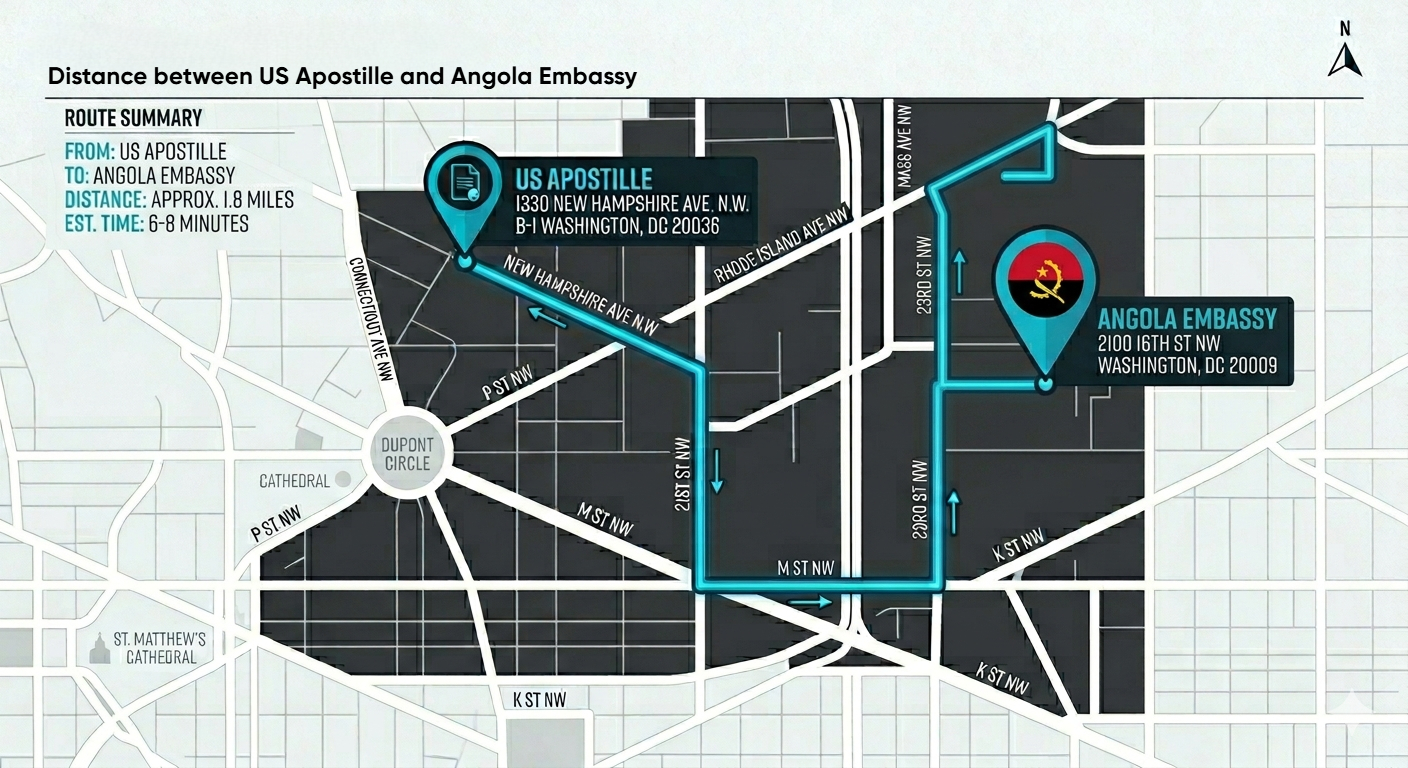
At US Apostille, we specialize in the specific and technical requirements of the Embassy of the Republic of Angola in Washington, D.C. We provide secure, hand-carry services to navigate the state, federal, and consular steps, ensuring your documents are legally valid for use in Angola.
The Angola Authentication Roadmap
To ensure acceptance in Angola, your documents must follow this precise sequence:
State Level: Notarization and certification from the Secretary of State (where the document originated).
Federal Level: Mandatory authentication by the U.S. Department of State in Washington, D.C.
Consular Level: Final legalization stamp from the Embassy of Angola.
Local Attestation: Your document is ready for the final verification at the Ministry of Foreign Affairs (MIREX) in Luanda.
Company Documents
Articles of Incorporation & Good Standing: Necessary for companies registering with the Guichet Único or the Ministry of Mineral Resources and Petroleum.
Power of Attorney: Specially legalized for legal representatives or directors managing affairs in Angola.
Commercial Invoices & Agency Agreements: Fully authenticated for customs clearance and trade operations.
Expert Insights for Angola Legalization (2026)
⚠️ The Portuguese Translation Rule: For 2026, the Angolan Embassy requires a certified Portuguese translation for all documents. Crucially, the U.S. Department of State seal must be applied to the Portuguese version. We coordinate this "Translation-First" workflow to ensure your package is not rejected.
⚠️ The "Grommet/Eyelet" Rule: The Embassy strictly requires that the original document and its translation be permanently bound together (grommeted) by the authenticating authority. Loose pages or simple staples are an automatic grounds for rejection.
⚠️ 2026 Fee Structure: Regular legalization fees at the Washington D.C. Embassy are typically $150 per document for civil and commercial records. We manage all U.S. Postal Money Order payments to ensure instant processing.